PREGNANCY
38 Weeks Pregnant: Let’s Talk About Labour
Time to get prepared on what to expect during the 3 stages of labor!

Written by
Dr. Harvey Karp
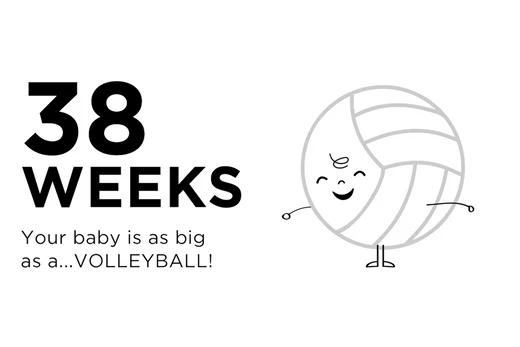
38 Weeks Pregnant: Baby at 38 Weeks
Just like you, your baby is ready for her grand entry! She weighs between 2.7 and 4 kilograms and is a bit more than 45 centimeters tall. Her brain is now ready for the next big job, life outside the womb. It is perfectly set to help her handle the impending flood of new sensations: bright lights, smiling faces, new smells, sounds, and touch.
And, her lungs are preparing for the big debut, too! That first breath is a huge life transition. Her lungs are filled with collapsed air sacs, but each tiny sac is coated with a special chemical that will keep them popped open after those first few lung expanding breaths.
The drama of entering a new world—the cool air on her wet body and the light on her face —triggers her brain to jump-start her breathing. Even at week 38, she is set to do it all. Nevertheless, waiting 60-90 seconds to clamp the umbilical cord will give her a boost of extra blood, oxygen, iron, and stem cells.
Because of their skinny legs and arms and big heads, babies have much more exposed skin than adults, so they lose heat quickly. To help warm her little body, your baby has stored up some special brown fat that generates extra heat and will be used up over the first day or two. Another great way to keep your little one toasty—and to begin bonding and start the breastfeeding process—is to have skin-to-skin contact right away.
38 Weeks Pregnant: What to Expect
Let us talk about one of the biggest things on your mind these days: labour. Your body is preparing for labour at 38 weeks of pregnancy.
Signs of Labour:
- You baby “drops”
- Your cervix dilates
- Increased cramps and back pain
- Diarrhea
- Stop gaining weight
- Increased fatigue and tiredness
- You lose your mucus plug and/or your vaginal discharge changes colour
- Stronger more frequent contractions
- Water breaks
Note: Cramping at 38 Weeks Pregnant: At 38 weeks you will experience increased cramps and pain in your lower back and groin as you approach labour. Your muscles and joints are beginning to shift and stretch in preparation for birth.
If you experience any of the above signs of labour at 38 weeks, then Congrats! Your baby is on the way. Here is what you need to know about the 3 stages of Labour.
Stage 1: Early Labour, Active Labour and Transition
Labour is divided into 3 stages. The first stage is the longest and consists of contractions, contractions and…yep, more contractions!
Note: Your uterus is a muscular sack. During labour, it alternates between tensing up (contraction) and relaxing. When it squeezes, the muscle pushes your baby downwards…pressing her head against your cervix. That thins the cervix (effacement) and starts to push the cervix open (dilatation).
Stage 1 usually gets off to a slow, creeping start. (The breaking of the bag of waters may be dramatic, but even that is usually more of a dribble than a flood.) Some women describe the start of stage 1 as period-like pain or a lower-back ache, but soon, the contractions strengthen, lengthen, and become more frequent. If you are a first-time mum, this stage will likely last 6-12 hours, but might drag on for a day or longer. (For a second-time mum, things can go a whole lot faster!)
If it is your first pregnancy—and you are low-risk—your care providers may have you stay home during most of this stage. Try to relax, stay hydrated, and eat light, carb-rich meals to keep your energy up. If you can sleep…do! Giving birth is a marathon, not a sprint, and you do not want to tire yourself out early on.
Your midwife will have told you to time your contractions (from the beginning of one to the beginning of the next—not to the end) and advised when to call her / head to the hospital.
When you arrive, your cervix will be checked to see how far you have dilated. It is possible you will be sent home or told to go out for a walk or a meal, if you need to dilate more.
Once you begin active labour, you will have strong contractions around a minute long and 3-5 minutes apart. It may be hard to talk or move easily. At this point, your cervix will be dilated 3-10 centimeters. (Dilating 1 cm/hr is textbook, but like in early labour, it is different for every woman.) If you are opting for an epidural, the time is…now!
Transition is the most intense stage. Luckily, it is also the shortest! You will be dilating those last few centimeters and your contractions will be coming quicker. Stage 1 ends when your cervix has stretched to 10 centimeters (fully dilated).
Note: Epidurals may weaken your contractions and prolong labour 40-90 minutes (and may even lead to more drugs—like Pitocin, which is given to amp up contractions.)
Stage 2: Delivering Your Baby When 38 Weeks Pregnant
When you are fully dilated, you will move on to pushing…which is an overwhelming muscular impulse, much like throwing up (but down there). Some women can control the pushing process, but if you are numb from an epidural, your midwife will likely coach you on when to push hard and when to slow down to allow your body to relax and open.
At some point, your baby’s head will emerge (some women ask for a mirror…to be able to see the baby’s head coming out). Next, they will ask you to push hard—again—to deliver her shoulders. Then, the rest of her body will slide out like a slippery, wet little fish. Unless there is a need for immediate medical care, your baby will be placed on your chest and covered with a warm blanket.
YOU. DID. IT! Congrats…you are a mum!!
Stage 3: Delivering the Placenta
But, Wait. There is more…
You are not 100% done yet…you need to deliver the placenta. Do not worry, it is the easiest stage and usually just slips right out after a few minutes.
If you want to breastfeed, start right away. (Bonus: Breastfeeding will cause your uterus to contract, help to expel the placenta and shrink in size.) You will also lose a lot of blood, about a pint. Your caregiver will massage your belly to get this blood out and to help your uterus go down. If you are not catheterised, you may be asked to pee because a full bladder can block the uterus from emptying all the way.
Your doctor or midwife will stitch up any tears or episiotomy cuts. If you have had an epidural, you will not feel this, but if you have not, you will be given a shot or two of local anesthesia. (That rarely hurts because the whole process usually makes the labia a bit numb.)
Note: After all this labour, you may find yourself shaking uncontrollably for minutes…or for over an hour. It may feel strange, but trust us: You are not dying! It is believed the shaking is caused by rapid hormonal shifts or the adrenaline of birth.
38 Weeks Pregnant: To-Do List
- Get food for labour: Labour is an athletic event. You will be thirsty and sweaty during…tired and sore afterward. The proper fuel can help: Eat a real meal or two in the early stages of labour (especially if your hospital has a policy against eating during active labour); sip on a drink with electrolytes, like coconut water; chomp on snacks that will boost your energy and keep your blood sugar up. And, after delivery, you might want hydrating fruits like watermelon, or fuel like a banana.
- Stock up on household basics: Toilet paper, laundry detergent, etc. Buy them now, so you do not have to run for more in the busy first week with baby.
- Do not forget the nipple cream: A lanolin—or shea-butter-based nipple cream can be soothing in the early days of breastfeeding. Bring it along to the hospital.
38 Week Pregnancy Fun Fact: Why Your Water Breaks
Your bag of waters is held by 2 membranes, and both must break to release your waters. Like much of pregnancy and childbirth, the exact reason why the water breaks is a mystery. However, we do know that the hormones that help the uterus to contract—prostaglandins—are partially responsible. The contractions also work to thin these membranes.
In the movies and on TV, just about every pregnant woman’s water breaks dramatically in a public place. In real life, for most women, it does not happen until you are in active labour. Some women’s water breaks early (this is called PROM, or premature rupture of membranes) and very rarely a baby is born en-caul or within an intact amniotic fluid sack.
38 Weeks Pregnant is How Many Months?
38 weeks pregnant is approximately 8 months and 3 weeks.
Pregnancy Quote of the Week
There is a secret in our culture, and it is not that birth is painful. It is that women are strong. — Laura Stavoe Harm
Disclaimer: The information on our site is NOT medical advice for any specific person or condition. It is only meant as general information. If you have any medical questions and concerns about your child or yourself, please contact your health provider. Breastmilk is the best source of nutrition for babies. It is important that, in preparation for and during breastfeeding, mothers eat a healthy, balanced diet. Combined breast- and bottle-feeding in the first weeks of life may reduce the supply of a mother's breastmilk and reversing the decision not to breastfeed is difficult. If you do decide to use infant formula, you should follow instructions carefully.






SHARE THIS ARTICLE
PARENT PICKS
Bestsellers